
Values by country
US Stamp Values: What Old American Stamps Are Worth, by Era
Updated · 5 min read · By the StampGo team
Quick answer
Most US stamps issued after about 1930 are common, worth cents used or around face value unused. Value concentrates in 19th-century issues, early 20th-century high values, scarce Washington-Franklin varieties and errors, and well-centered unused copies are worth the most. StampGo identifies a US stamp from a photo and shows its year and a reference price.
Key facts
- First US stamps
- 1847: the 5¢ Benjamin Franklin and the 10¢ George Washington
- Standard catalogue
- Scott Specialized Catalogue of United States Stamps & Covers
- Usually valuable
- 19th-century issues in good condition, early high values and errors
- Usually common
- Most stamps after about 1930, and most 1¢–3¢ definitives
- Tricky series
- Washington-Franklin Heads (1908–1922), with about 250 varieties
- Still valid for postage
- All US stamps issued since 1860
What are US stamps worth by era?
Value generally falls as you move forward in time. Classic 19th-century issues hold the most value, the 1900s–1920s are mixed, and most stamps from the 1930s on are common unless they're errors or scarce varieties.
| Era | Examples | Typical value |
|---|---|---|
| 1847–1869 (classics) | 1847 Franklin and Washington, 1851–1857 issues, 1869 Pictorials | Tens to thousands of dollars, depending on condition |
| 1870–1900 | Bank Note issues, 1893 Columbians, 1898 Trans-Mississippi | Common low values cost a few dollars; high values can be worth hundreds |
| 1901–1930 | Pan-American, Washington-Franklins, 1920s definitives | Mostly modest, but high values and varieties can be valuable |
| 1930–1970 | Commemoratives, the Presidential (“Prexie”) and Liberty series | Mostly common: cents used, near face value unused |
| 1970–today | Commemoratives and Forever stamps | Face value or less, unless it's an error |
Which old US stamps are worth money?
The best candidates are unused 19th-century stamps, the high values of the 1893 Columbian and 1898 Trans-Mississippi issues, scarce Washington-Franklin varieties, early airmail and printing errors.
- The 1847 and 1851–1857 issues, in sound condition.
- The 1869 Pictorials, the first US stamps to show scenes rather than only portraits.
- Columbian Exposition high values (1893), from $1 to $5.
- Trans-Mississippi high values (1898), such as the $1 “Western Cattle in Storm”.
- Washington-Franklin varieties with scarce perforations or watermarks. See our guide.
- Early airmail, including the 1918 24¢ Jenny, whose inverted version is the famous Inverted Jenny.
- Errors such as inverts and imperforates. See error stamps.
What are 1, 2 and 3 cent US stamps worth?
Most 1¢, 2¢ and 3¢ US stamps are worth a few cents to a dollar, because they were printed in the billions for everyday mail. The exceptions are 19th-century issues, scarce varieties and unused, well-centered classics.
Low values were the workhorses of the postal system. The 2¢ stamp paid the first-class letter rate for most of 1883–1932, and the 3¢ from 1932 to 1958, which is exactly why they're common. The valuable ones are usually older printings, or versions that differ in perforation, watermark or printing method, such as certain Washington-Franklin 1¢ and 2¢ varieties.
The 3¢ Statue of Liberty (1954) and the 3¢ Jefferson from the 1938 Presidential series are among the most common stamps in American albums, and they're typically worth a few cents.
How do I look up a US stamp's value?
Find the stamp's Scott number, check its condition and compare recent sale prices. A stamp identifier app can find the issue from a photo, which is the slowest step when you're starting out.
The Scott Specialized Catalogue of United States Stamps & Covers is the standard reference, and dealers and auctions describe US stamps by Scott number. For the Washington-Franklins and other issues with look-alike varieties, you'll also need a perforation gauge and a watermark tray. See how to identify stamps.
Can I still use old US stamps for postage?
Yes. US postage stamps issued since 1860 remain valid at face value, so common unused stamps are still useful even when they have little collector value.
If you have sheets of common unused stamps from the 1960s–1990s, using them on mail usually returns more than selling them. Keep anything older, rare-looking or misprinted aside to check first.
What are US airmail stamps worth?
Most US airmail stamps from the 1940s onward are common. The valuable ones are early issues: the 1918 Jenny stamps, the 1930 Graf Zeppelin set and the 1933 “Century of Progress” Zeppelin, especially unused and well centered.
| Airmail issue | What to know |
|---|---|
| 1918 Curtiss Jenny (6¢, 16¢, 24¢) | The first US airmail stamps. The 24¢ with an inverted plane is the Inverted Jenny |
| 1930 Graf Zeppelin (65¢, $1.30, $2.60) | Issued for the airship's Europe–Pan-American flight. The set is valuable, especially unused |
| 1933 Century of Progress Zeppelin (50¢) | The “Baby Zeppelin”, worth more than most airmail of its era |
| 1940s–1970s airmail | Mostly common, apart from errors |
The Graf Zeppelin stamps were expensive when issued and relatively few were sold, which is why they're still sought after. Fakes and regummed copies exist, so certificates are common for well-centered unused sets. Airmail stamps on flown covers, envelopes carried on notable flights, can be worth more than the stamps alone, so keep those intact.
Step by step
How to look up US stamp values with StampGo
StampGo recognizes US stamps from the 1800s to today and shows the issue, year and a typical price, so you can quickly separate the common stamps from the valuable ones.
- 1
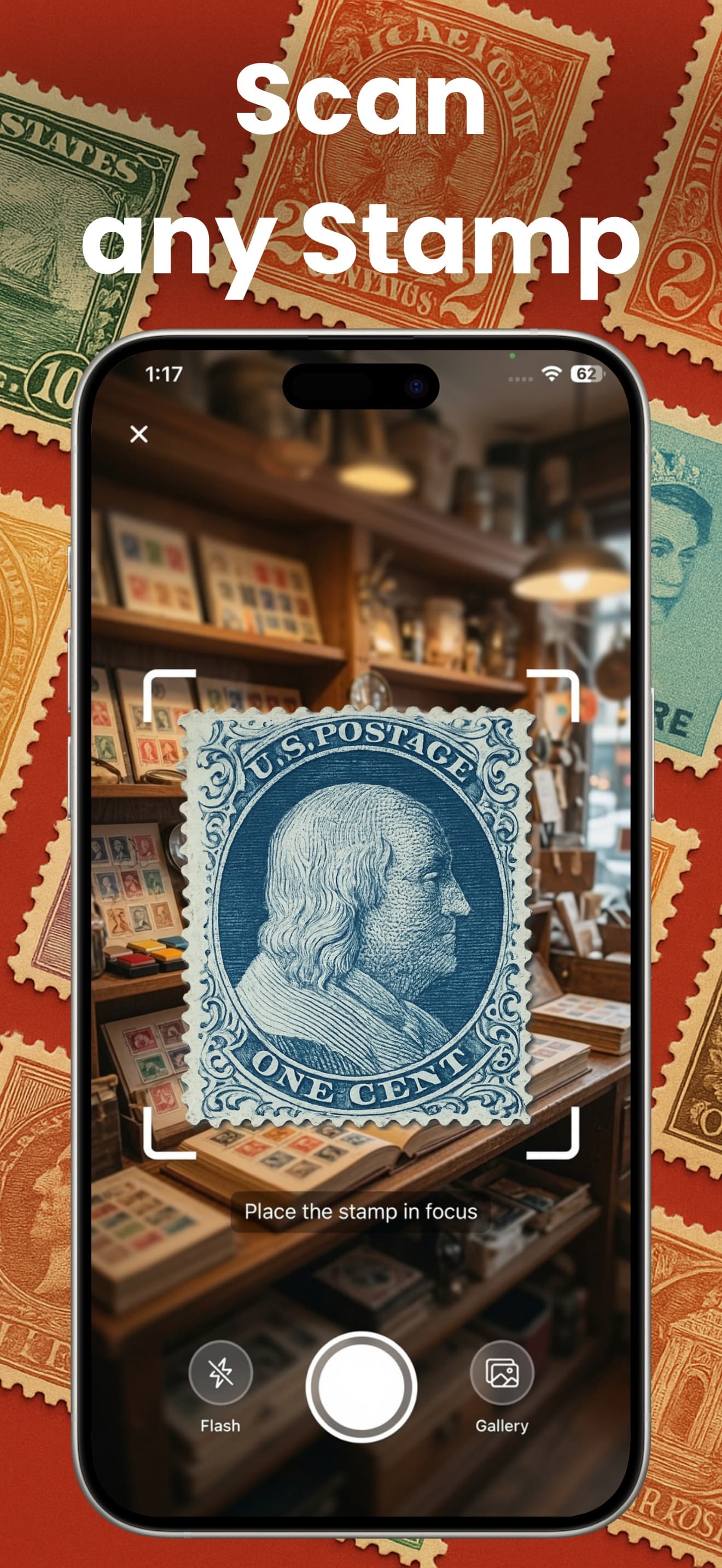
Scan the stamp
Tap Scan Now and photograph one US stamp at a time.
- 2
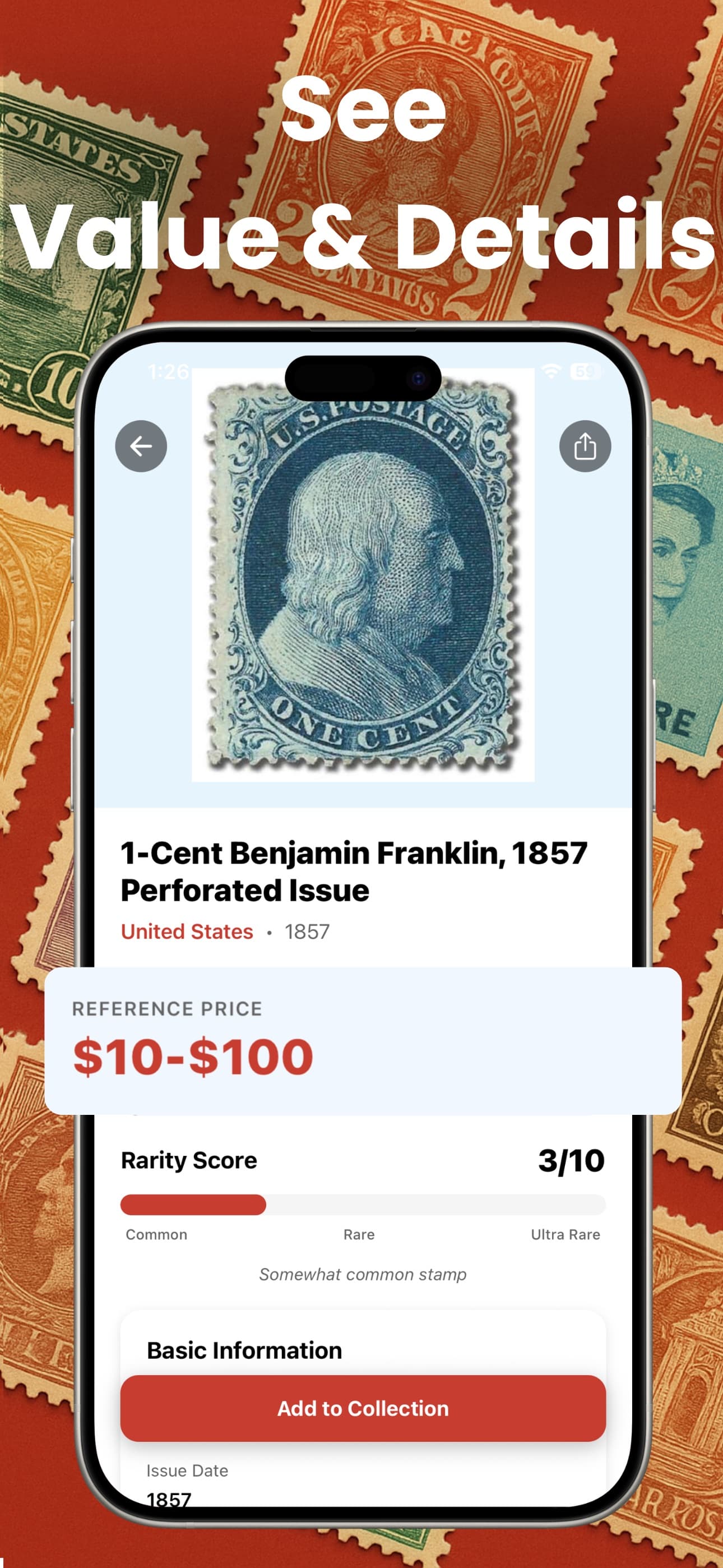
See the issue and year
StampGo names the stamp, for example “1-Cent Benjamin Franklin, 1857 Perforated Issue”, with its year and a reference price range.
- 3
Check the rarity score
Use the 1–10 rarity score to decide which stamps need a closer look at perforations, watermark and condition.
- 4
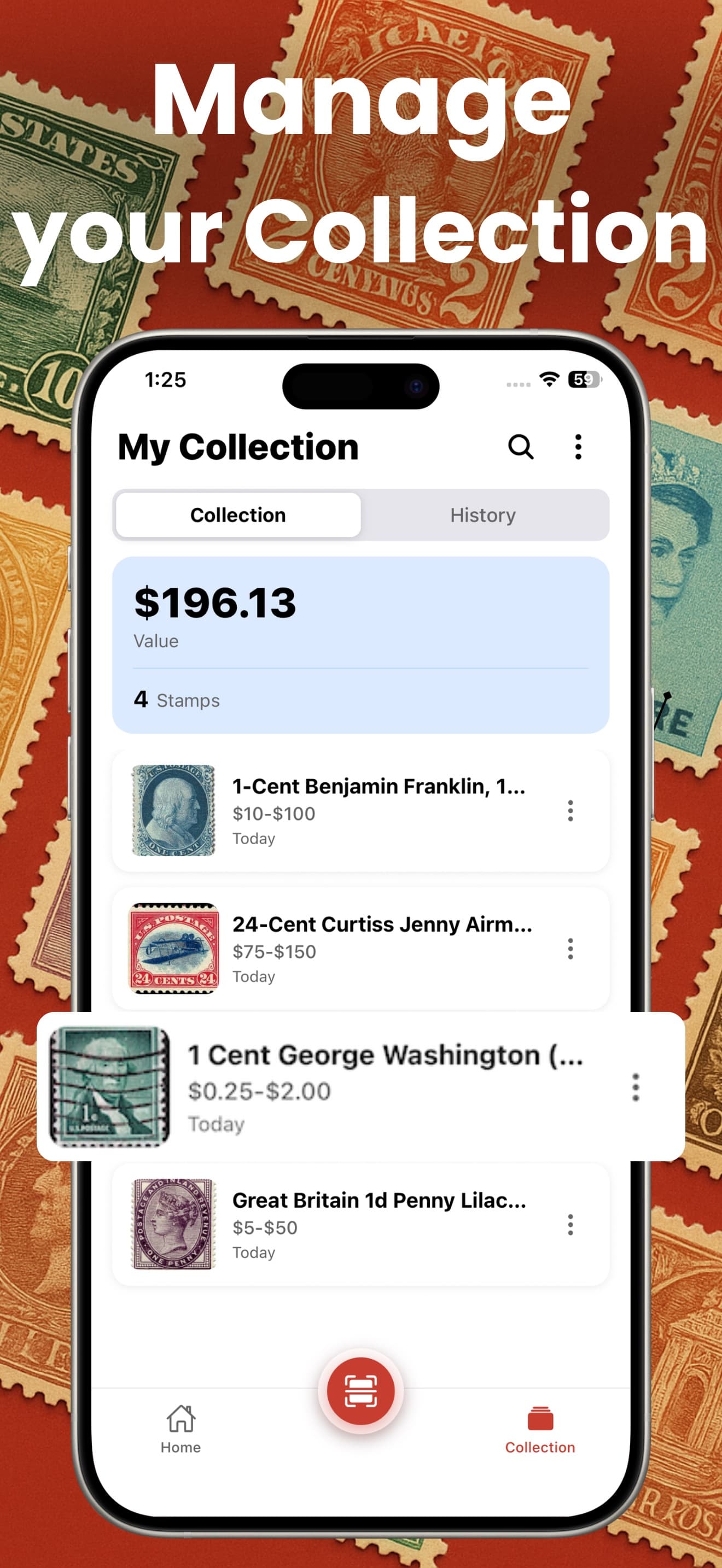
Build your US collection
Save stamps to your collection and track their total value as you go.


Free to download on iOS and Android
Frequently asked questions
What is the most valuable US stamp?
The 1868 1¢ Z Grill, of which only two are known, and the 1918 Inverted Jenny are among the most valuable US stamps. Both have changed hands for more than a million dollars.
Are old US stamps worth anything?
Some are. Most 20th-century US stamps are common, but 19th-century issues, early high values and scarce varieties can be worth tens to thousands of dollars.
Which US stamps should I look for?
Unused 19th-century stamps, the $1–$5 Columbians, Trans-Mississippi high values, early airmail, Washington-Franklin varieties and anything that looks misprinted.
Are Forever stamps worth more than face value?
Not as collectibles. A Forever stamp is always valid for the current one-ounce First-Class Mail letter rate, which makes it useful postage rather than an investment. See Forever stamp value for the current rate.
