
Identify stamps
How to Identify Stamps: Country, Year and Variety, Step by Step
Updated · 6 min read · By the StampGo team
Quick answer
To identify a stamp, work out the country from its inscription or design, read the denomination and currency, then narrow down the year from the design, color and a catalogue. Perforations, watermark and printing method separate look-alike varieties. StampGo handles the first steps from a photo and returns the issue name, country and year.
Key facts
- First check
- Country, from the inscription, script, currency or portrait
- Then
- Denomination, color and design, to find the issue
- Look-alike varieties
- Separated by perforation gauge, watermark, paper and printing method
- Standard catalogues
- Scott (US), Stanley Gibbons (UK and Commonwealth), Michel (Germany and Europe), Yvert et Tellier (France)
- Useful tools
- Magnifier, stamp tongs, perforation gauge, watermark tray
- No country name?
- Almost certainly Great Britain, the one country that doesn't print its name
How do I tell which country a stamp is from?
Start with the inscription. Most stamps name their country, often in the local language. If there's no name, the currency, script and portrait are the next clues, and a stamp showing only a monarch's head is almost always British.
| Inscription on the stamp | Country |
|---|---|
| Helvetia | Switzerland |
| Magyar Posta / Magyar Kir. Posta | Hungary |
| Nippon / 日本郵便 | Japan |
| Deutsches Reich / Deutsche Bundespost | Germany |
| Österreich | Austria |
| Sverige | Sweden |
| Norge | Norway |
| Suomi | Finland |
| Polska | Poland |
| España / Correos | Spain |
| Éire | Ireland |
| RF / République Française | France |
| Hellas / ΕΛΛΑΣ | Greece |
| CCCP | Soviet Union (USSR) |
Great Britain is the only country that doesn't have to print its name, because it issued the world's first stamp, the Penny Black, in 1840. British stamps show the reigning monarch's head instead.
How do I read a stamp's denomination and currency?
The denomination is the number printed on the stamp, and the currency symbol or word points to the country and era. For example, “d” means old British pence and “Pf” means German pfennig.
- d and s: pre-1971 British pence and shillings (the “d” comes from the Latin denarius).
- p: British decimal pence, used from February 1971 onwards.
- c or ¢: cents, used by the US, Canada, the Netherlands and many others.
- Pf / Rpf: German pfennig and Reichspfennig.
- Kr / Øre: Scandinavian krone and øre.
- F / c: French francs and centimes.
- “Forever” with no value: modern US non-denominated stamps. See Forever stamp value.
The currency is also a dating clue. A British stamp priced in decimal “p” was issued in 1971 or later, while one priced in “d” dates from before decimalization.
How can I tell what year a stamp was issued?
Many modern stamps print the year in small type along the bottom edge. For older stamps, match the design, color and denomination against a catalogue, which lists every issue by date.
Clues that narrow the date include the ruler or head of state shown (a British stamp portraying Queen Victoria predates 1902), the currency, the printing style (engraved, typographed, lithographed or photogravure) and whether the stamp is perforated at all. Most stamps issued before the mid-1850s were imperforate and had to be cut apart with scissors.
A full catalogue such as Scott (US and worldwide), Stanley Gibbons (Britain and the Commonwealth) or Michel (Germany and Europe) gives the issue date and a catalogue number. That number is how dealers and auction houses describe stamps.
Why do two identical-looking stamps have different values?
Many designs were printed several times with small differences in perforation, watermark, paper or printing method. Some of those versions are far scarcer, and worth far more, than others.
- Perforation gauge. Count the holes per 2 cm with a perforation gauge. “Perf 12” means 12 holes in 2 cm, and different gauges can mean different issues.
- Watermark. A pattern pressed into the paper. You see it by laying the stamp face down in a black watermark tray, with watermark fluid if needed.
- Printing method. Flat-plate and rotary-press printings of the same design can differ slightly in size.
- Paper and gum. Paper color, thickness and gum type distinguish some issues.
Does condition matter when identifying a stamp?
Condition doesn't change what a stamp is, but it changes what it's worth. Once you know the issue, check the centering, perforations, gum and any faults to place its value within the catalogue range.
Our stamp condition grading guide explains the terms dealers use, such as MNH, VF and “thin”, and how much each affects price.
Can I identify a stamp by picture?
Yes. A stamp identifier app compares a photo with a database of known stamps and returns the country, year and issue name, which is usually the slowest part of doing it by hand.
A photo won't measure perforation gauge or reveal a watermark, but it gets you to the right issue in seconds. After that, you only need tools for the stamps where varieties matter, typically classic issues with a high rarity score. See our guide to the free stamp identifier app for what to expect.
Step by step
How to identify a stamp with StampGo
StampGo covers the first four checks in one step. Reach for the perforation gauge only when the result tells you a stamp deserves it.
- 1
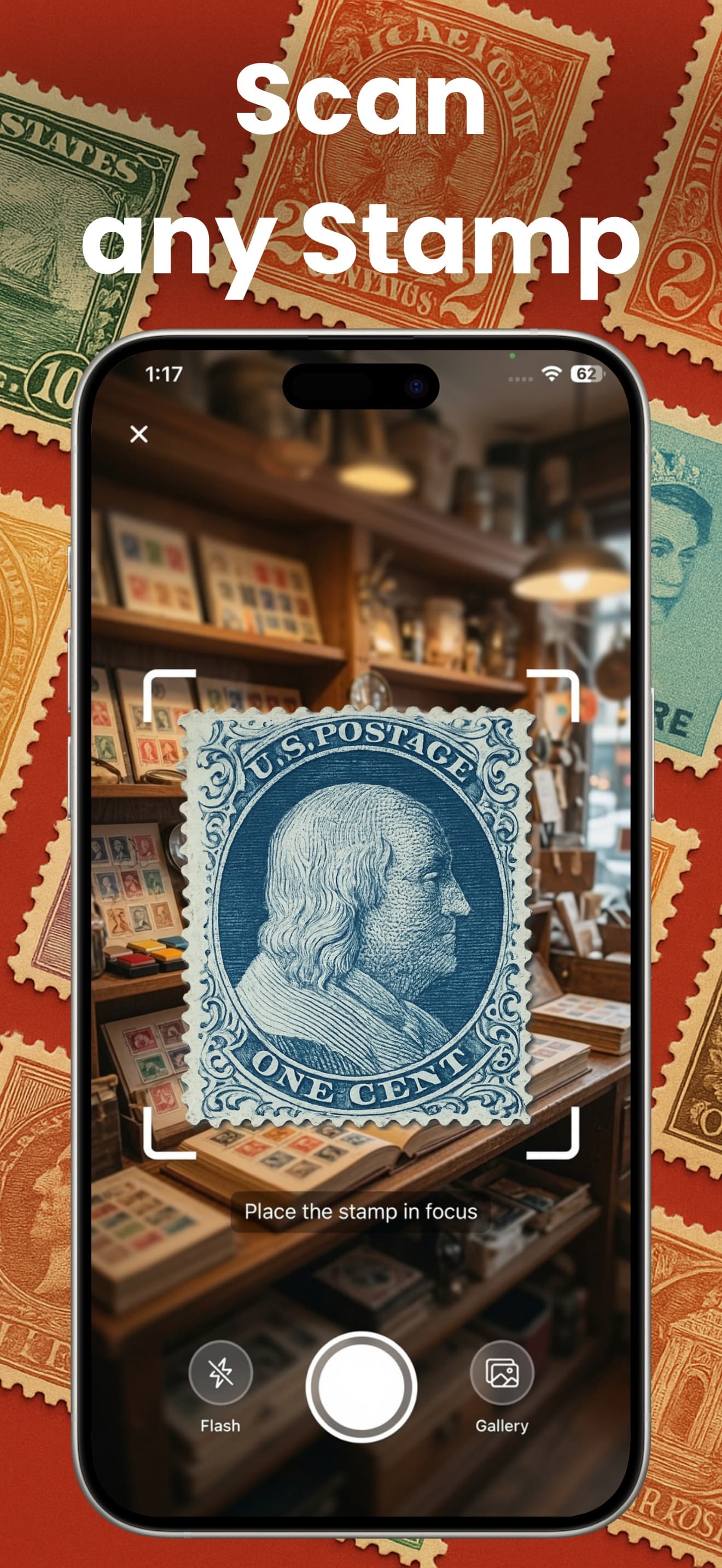
Scan the stamp
Tap Scan Now and photograph one stamp, flat and in good light, or choose a photo from your gallery.
- 2
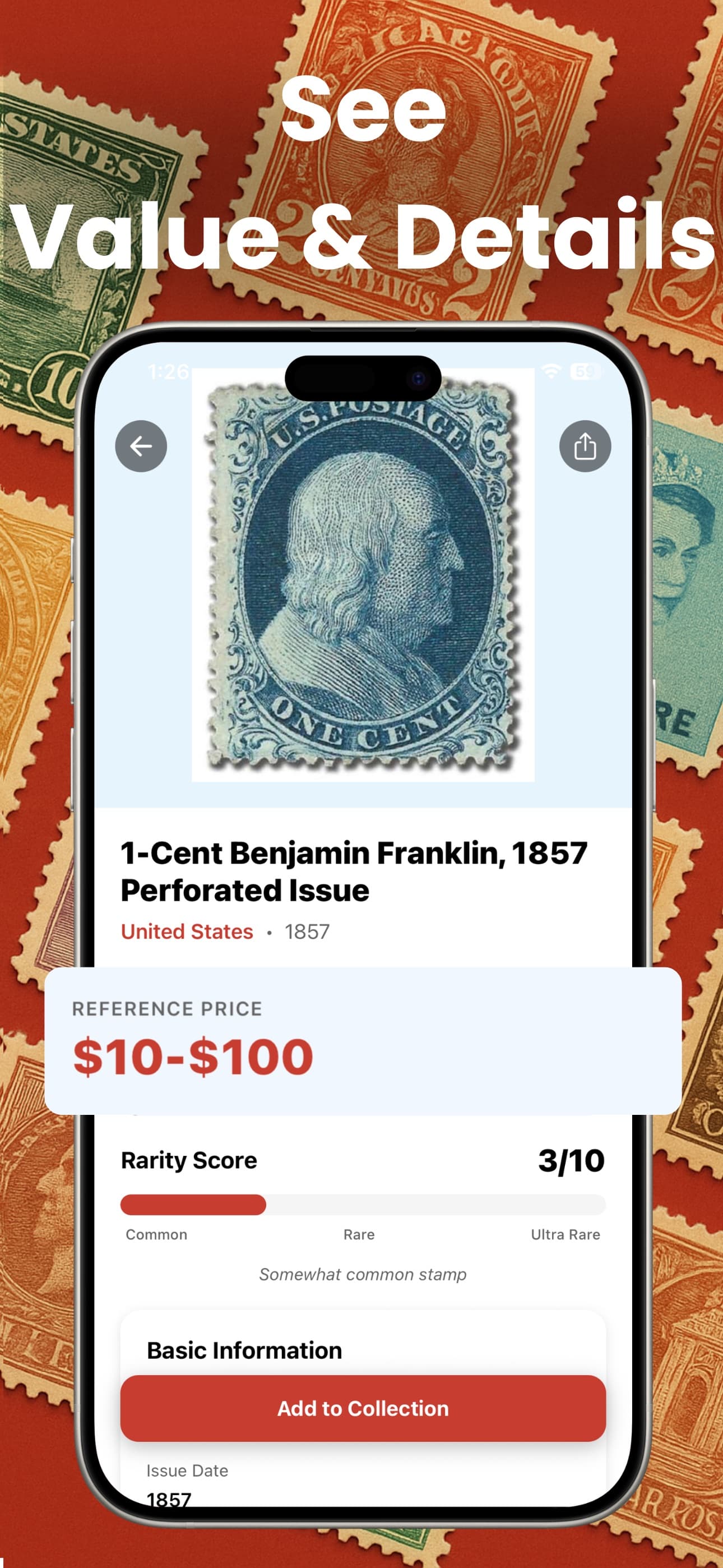
Check the identification
StampGo shows the stamp's name, country, year and denomination, plus its postal system, currency and background.
- 3
Let rarity decide what's next
A low rarity score means you can move on. A high one is your cue to check perforations, watermark and condition before you value it.
- 4
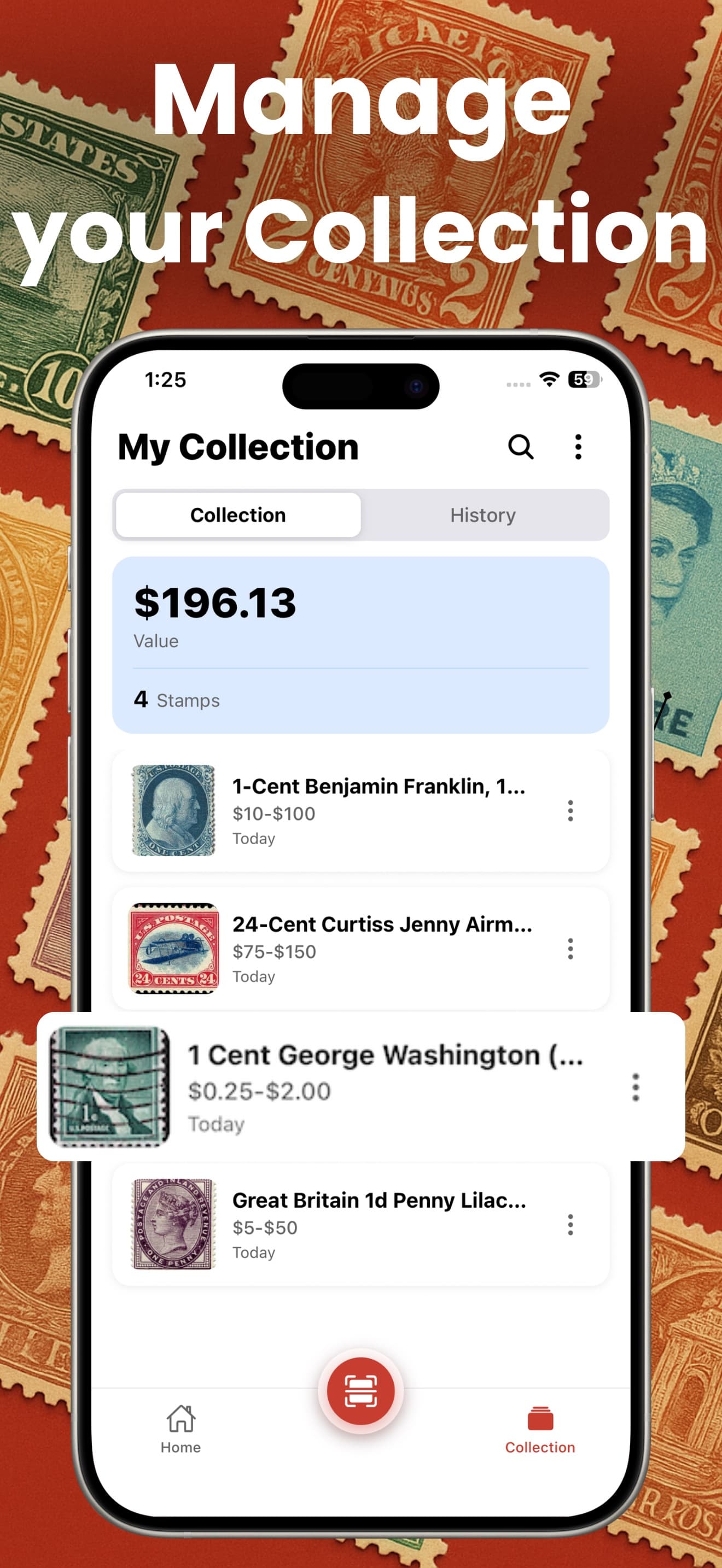
Save it and keep sorting
Add the stamp to your collection. The History tab keeps every scan, so you never identify the same stamp twice.


Free to download on iOS and Android
Frequently asked questions
How do I get a stamp identification and value at the same time?
Identify the issue first, because the value depends on it, then check the condition and recent sale prices. StampGo does the first part from one photo and shows a reference price range alongside the issue.
What is the easiest way to identify old stamps?
Photograph them with a stamp identifier app to get the country and issue, then check any valuable-looking ones against a catalogue. That's much faster than paging through catalogues when you don't know the country.
What does “perf 12” mean?
It means the stamp has 12 perforation holes per 2 centimeters along that edge. Measuring it with a perforation gauge separates varieties that otherwise look identical.
How do I find a stamp's watermark?
Lay the stamp face down in a black watermark tray and, if needed, add a drop of watermark fluid (first check it's safe for that stamp's ink). The watermark shows as a darker pattern in the paper.
Which stamp catalogue should I use?
Scott is the standard in the US, Stanley Gibbons in the UK and Commonwealth, and Michel in Germany and much of Europe. Free online databases are a good starting point before you buy a printed catalogue.
