
Berühmte Marken
Briefmarken mit Washington und Franklin: Was Ihre wert ist
Aktualisiert · 5 Min. Lesezeit · Vom StampGo-Team
Kurze Antwort
Die meisten Marken mit George Washington und Benjamin Franklin sind wenige Cent bis wenige Dollar wert, weil sie als US-Alltagsmarken in Milliardenauflage erschienen. Einige bringen Hunderte oder mehr: Ausgaben des 19. Jahrhunderts und seltene Varianten der Serie von 1908 bis 1922, die sich nur in Zähnung, Wasserzeichen und Druckverfahren unterscheiden. StampGo erkennt die Ausgabe per Foto.
Die wichtigsten Fakten
- Warum sie überall sind
- Washington und Franklin erscheinen seit der ersten Ausgabe 1847 auf US-Marken
- Die kniffelige Serie
- Washington-Franklin-Köpfe (1908–1922): rund 250 verschiedene Marken
- Was Varianten trennt
- Zähnungsmaß, Wasserzeichen, Flachdruck oder Rotationsdruck und Papier
- Alltägliche Niedrigwerte
- 1 Cent grün und 2 Cent rot, in Milliardenauflage gedruckt
- Am wertvollsten
- Seltene Kombinationen aus Zähnung und Wasserzeichen, Rollenmarken, Fehldrucke und frühe Ausgaben
- Benötigte Werkzeuge
- Zähnungsschlüssel, Wasserzeichenschale, Millimeterlineal
How much is a George Washington stamp worth?
Most George Washington stamps are worth a few cents to a dollar. Washington appeared on the most common US stamps for over a century, so the value depends on the exact issue, variety and condition, not the portrait.
| Stamp | Typical value |
|---|---|
| Common 20th-century Washington stamps (1¢–3¢), used | A few cents |
| Washington-Franklin Heads (1908–1922), common varieties | Cents to a few dollars |
| Washington-Franklin Heads, scarce perforation or watermark varieties | Tens to hundreds of dollars, sometimes more |
| 19th-century Washington issues (1847–1890s) | Dollars to thousands, depending on the issue and condition |
| The 1932 Washington Bicentennial set | Mostly common |
The red 2¢ Washington, the letter-rate stamp for decades, is the classic example. Billions were used, so most are worth a few cents, but certain varieties printed on the wrong paper, perforated differently or from a different press are worth far more.
How much is a Benjamin Franklin stamp worth?
Most Franklin stamps are common too, but early Franklin issues can be valuable. The 1847 5¢ Franklin was one of the first two US stamps, and the 1¢ Franklins of the 1850s–60s are worth checking.
Franklin, the first Postmaster General, has appeared on US stamps since 1847. The 1¢ blue Franklin of 1851–1861 comes in several types that specialists separate by tiny design differences, and the 1861–1866 1¢ Franklin in StampGo's own screenshots carries a $15–$75 reference range. In the Washington-Franklin series, Franklin appears on the 1908 1¢ and, from 1912, on the higher values.
The rarest of all is the 1868 1¢ Franklin “Z Grill”, with only two known. It's one of the most valuable US stamps. See US stamp values.
Why is the Washington-Franklin series so hard to identify?
About 250 different stamps share a handful of designs. They were printed between 1908 and 1922 with different perforations, watermarks, papers and presses, and some combinations are far scarcer than others.
- Perforation gauge: perf 12, 10, 8½ or compound gauges such as 12 × 10, plus imperforate and coil stamps.
- Watermark: a double-line “USPS”, a single-line “USPS”, or none.
- Printing method: flat-plate and rotary-press stamps of the same design differ slightly in size.
- Paper: most were printed on ordinary paper, but some were printed on bluish or other unusual papers.
How do I identify my Washington or Franklin stamp?
Start with the denomination, color and design to find the issue, then measure the perforation gauge, check the watermark and measure the size to pin down the exact variety.
A photo gets you to the issue. For Washington-Franklins, the rest needs a perforation gauge, a watermark tray and a millimeter ruler. Our guide to how to identify stamps explains each tool.
Are 1 cent and 2 cent Washington stamps worth anything?
Usually only a few cents, because they were printed in the billions to pay everyday postage. The exceptions are scarce varieties and unused, well-centered copies of early issues.
Condition matters a lot for the better varieties, so check centering and gum before you compare prices. See stamp condition grades.
What's the difference between flat-plate and rotary-press stamps?
They're the same designs printed on different presses. Rotary-press stamps were printed from curved plates, which stretched the image slightly, so they're a fraction of a millimeter taller or wider than flat-plate stamps of the same design.
Rotary presses were first used for coil stamps in the mid-1910s and later for sheet stamps. To tell the two apart, measure the printed design with a millimeter ruler and compare it with a catalogue's dimensions. Many rotary-press stamps from the 1920s onward also show faint ridges on the back from gum breakers, which were used to stop the sheets curling.
It matters because some Washington-Franklin values are common in one printing and scarce in the other, even with the same perforation and watermark. That's why careful collectors check all three: perforation, watermark and press.
Schritt für Schritt
How to check a Washington or Franklin stamp with StampGo
StampGo narrows down which Washington or Franklin issue you have from a photo, so you know whether it's worth getting out the perforation gauge.
- 1
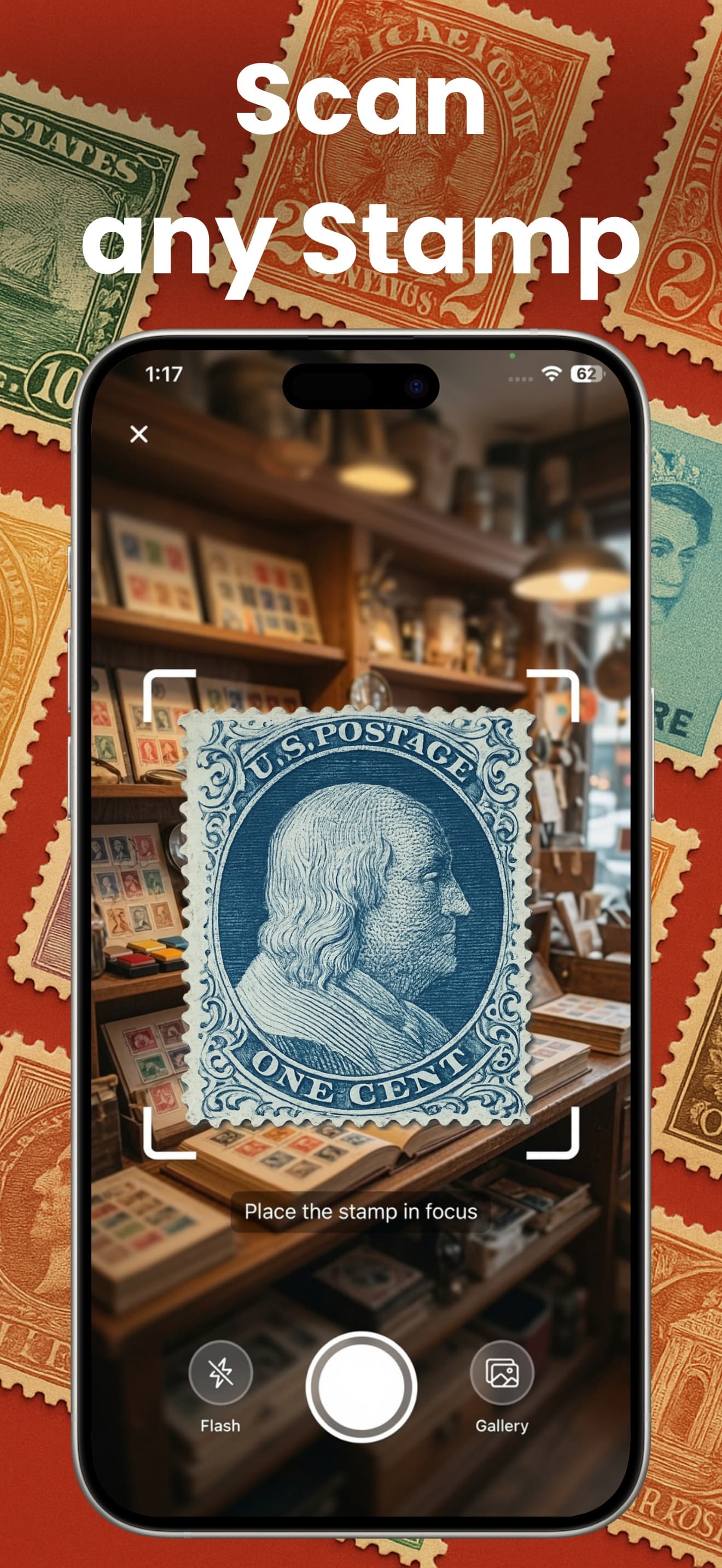
Scan the stamp
Tap Scan Now and photograph the stamp flat, with all four edges visible.
- 2
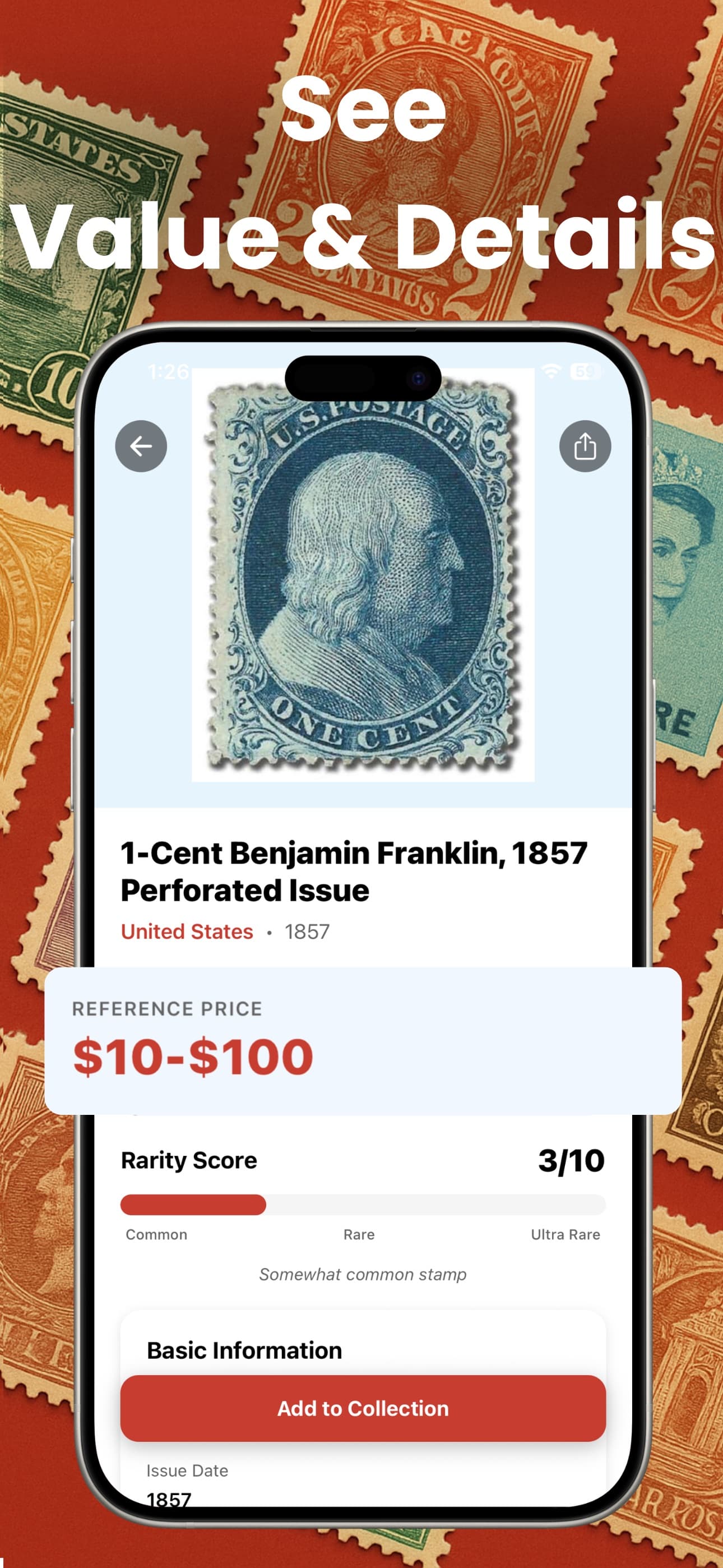
See the issue and price range
StampGo names the issue, such as the “1-Cent Benjamin Franklin, 1857 Perforated Issue”, with its year and a reference price.
- 3
Check varieties if it's promising
If the rarity score or price range is high, measure the perforations and check the watermark to pin down the exact variety.
- 4
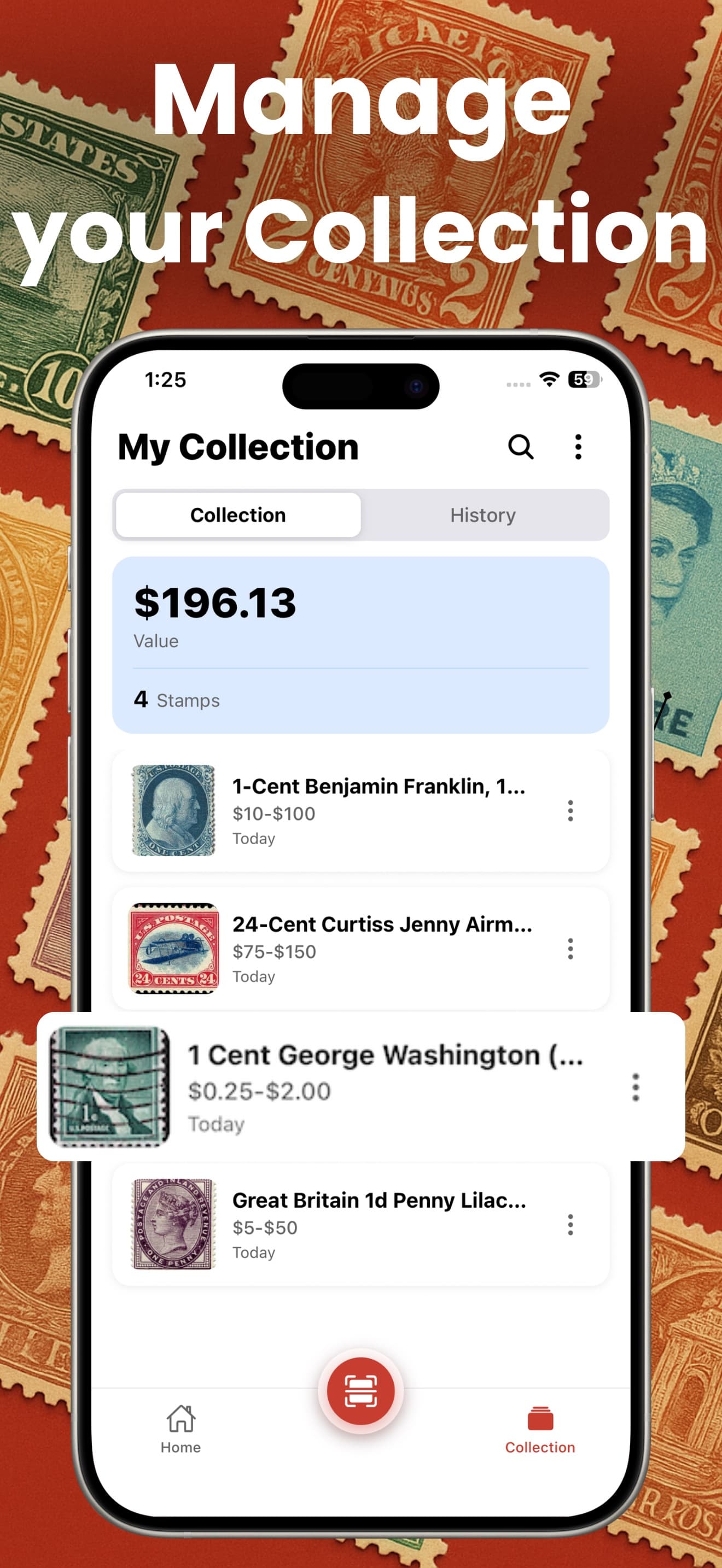
Save it to your collection
Add it to your collection. The app's screenshots show a 1¢ George Washington at $0.25–$2.00, which is typical for a common issue.


Kostenloser Download für iOS und Android
Häufige Fragen
Was ist eine rote George-Washington-Marke wert?
Die meisten roten 2-Cent-Washington-Marken von 1890 bis 1930 sind gestempelt wenige Cent wert. Einige Varianten der Serie von 1908 bis 1922, erkennbar an Zähnung und Wasserzeichen, bringen deutlich mehr.
Welche Benjamin-Franklin-Marke ist am wertvollsten?
Der 1-Cent-Franklin-Z-Grill von 1868, von dem nur zwei Stücke bekannt sind, zählt zu den wertvollsten US-Marken.
Welche George-Washington-Marke ist am wertvollsten?
Die höchsten Preise erzielen seltene frühe Washington-Ausgaben und seltene Washington-Franklin-Varianten wie bestimmte Rollenmarken und Zähnungsvarianten. Über den Wert entscheiden die genaue Variante und die Erhaltung.
Brauche ich für Washington-Franklin-Marken einen Zähnungsschlüssel?
Ja, für alles über die erste Bestimmung hinaus. Zähnung, Wasserzeichen und Druckverfahren sind genau das, was eine häufige von einer seltenen Washington-Franklin-Marke trennt.
Warum gibt es so viele Washington-Franklin-Varianten?
In den 14 Jahren der Serie wechselte das Bureau of Engraving and Printing im Zuge der Modernisierung Papiere, Wasserzeichen, Zähnungsmaschinen und Pressen. Jede Änderung schuf neue Varianten derselben Motive.
