
Sellos famosos
Sellos de Washington y Franklin: cuánto vale el tuyo
Actualizado el · 6 min de lectura · Por el equipo de StampGo
Respuesta rápida
La mayoría de los sellos de George Washington y Benjamin Franklin valen de unos céntimos a unos pocos dólares, porque eran sellos estadounidenses de uso diario impresos por miles de millones. Algunos valen cientos o más: las emisiones del siglo XIX y las variedades escasas de la serie Washington-Franklin de 1908 a 1922, que solo se diferencian por el dentado, la filigrana y el método de impresión. StampGo identifica la emisión por foto.
Datos clave
- Por qué están por todas partes
- Washington y Franklin aparecen en sellos de EE. UU. desde la primera emisión de 1847
- La serie complicada
- Las cabezas Washington-Franklin (1908–1922): unos 250 sellos distintos
- Qué separa las variedades
- Dentado, filigrana, impresión plana o rotativa, y papel
- Valores bajos del día a día
- El de 1 centavo verde y el de 2 centavos rojo, impresos por miles de millones
- Los más valiosos
- Combinaciones escasas de dentado y filigrana, sellos en rollo, errores y emisiones tempranas
- Herramientas necesarias
- Odontómetro, cubeta de filigranas, regla milimetrada
How much is a George Washington stamp worth?
Most George Washington stamps are worth a few cents to a dollar. Washington appeared on the most common US stamps for over a century, so the value depends on the exact issue, variety and condition, not the portrait.
| Stamp | Typical value |
|---|---|
| Common 20th-century Washington stamps (1¢–3¢), used | A few cents |
| Washington-Franklin Heads (1908–1922), common varieties | Cents to a few dollars |
| Washington-Franklin Heads, scarce perforation or watermark varieties | Tens to hundreds of dollars, sometimes more |
| 19th-century Washington issues (1847–1890s) | Dollars to thousands, depending on the issue and condition |
| The 1932 Washington Bicentennial set | Mostly common |
The red 2¢ Washington, the letter-rate stamp for decades, is the classic example. Billions were used, so most are worth a few cents, but certain varieties printed on the wrong paper, perforated differently or from a different press are worth far more.
How much is a Benjamin Franklin stamp worth?
Most Franklin stamps are common too, but early Franklin issues can be valuable. The 1847 5¢ Franklin was one of the first two US stamps, and the 1¢ Franklins of the 1850s–60s are worth checking.
Franklin, the first Postmaster General, has appeared on US stamps since 1847. The 1¢ blue Franklin of 1851–1861 comes in several types that specialists separate by tiny design differences, and the 1861–1866 1¢ Franklin in StampGo's own screenshots carries a $15–$75 reference range. In the Washington-Franklin series, Franklin appears on the 1908 1¢ and, from 1912, on the higher values.
The rarest of all is the 1868 1¢ Franklin “Z Grill”, with only two known. It's one of the most valuable US stamps. See US stamp values.
Why is the Washington-Franklin series so hard to identify?
About 250 different stamps share a handful of designs. They were printed between 1908 and 1922 with different perforations, watermarks, papers and presses, and some combinations are far scarcer than others.
- Perforation gauge: perf 12, 10, 8½ or compound gauges such as 12 × 10, plus imperforate and coil stamps.
- Watermark: a double-line “USPS”, a single-line “USPS”, or none.
- Printing method: flat-plate and rotary-press stamps of the same design differ slightly in size.
- Paper: most were printed on ordinary paper, but some were printed on bluish or other unusual papers.
How do I identify my Washington or Franklin stamp?
Start with the denomination, color and design to find the issue, then measure the perforation gauge, check the watermark and measure the size to pin down the exact variety.
A photo gets you to the issue. For Washington-Franklins, the rest needs a perforation gauge, a watermark tray and a millimeter ruler. Our guide to how to identify stamps explains each tool.
Are 1 cent and 2 cent Washington stamps worth anything?
Usually only a few cents, because they were printed in the billions to pay everyday postage. The exceptions are scarce varieties and unused, well-centered copies of early issues.
Condition matters a lot for the better varieties, so check centering and gum before you compare prices. See stamp condition grades.
What's the difference between flat-plate and rotary-press stamps?
They're the same designs printed on different presses. Rotary-press stamps were printed from curved plates, which stretched the image slightly, so they're a fraction of a millimeter taller or wider than flat-plate stamps of the same design.
Rotary presses were first used for coil stamps in the mid-1910s and later for sheet stamps. To tell the two apart, measure the printed design with a millimeter ruler and compare it with a catalogue's dimensions. Many rotary-press stamps from the 1920s onward also show faint ridges on the back from gum breakers, which were used to stop the sheets curling.
It matters because some Washington-Franklin values are common in one printing and scarce in the other, even with the same perforation and watermark. That's why careful collectors check all three: perforation, watermark and press.
Paso a paso
How to check a Washington or Franklin stamp with StampGo
StampGo narrows down which Washington or Franklin issue you have from a photo, so you know whether it's worth getting out the perforation gauge.
- 1
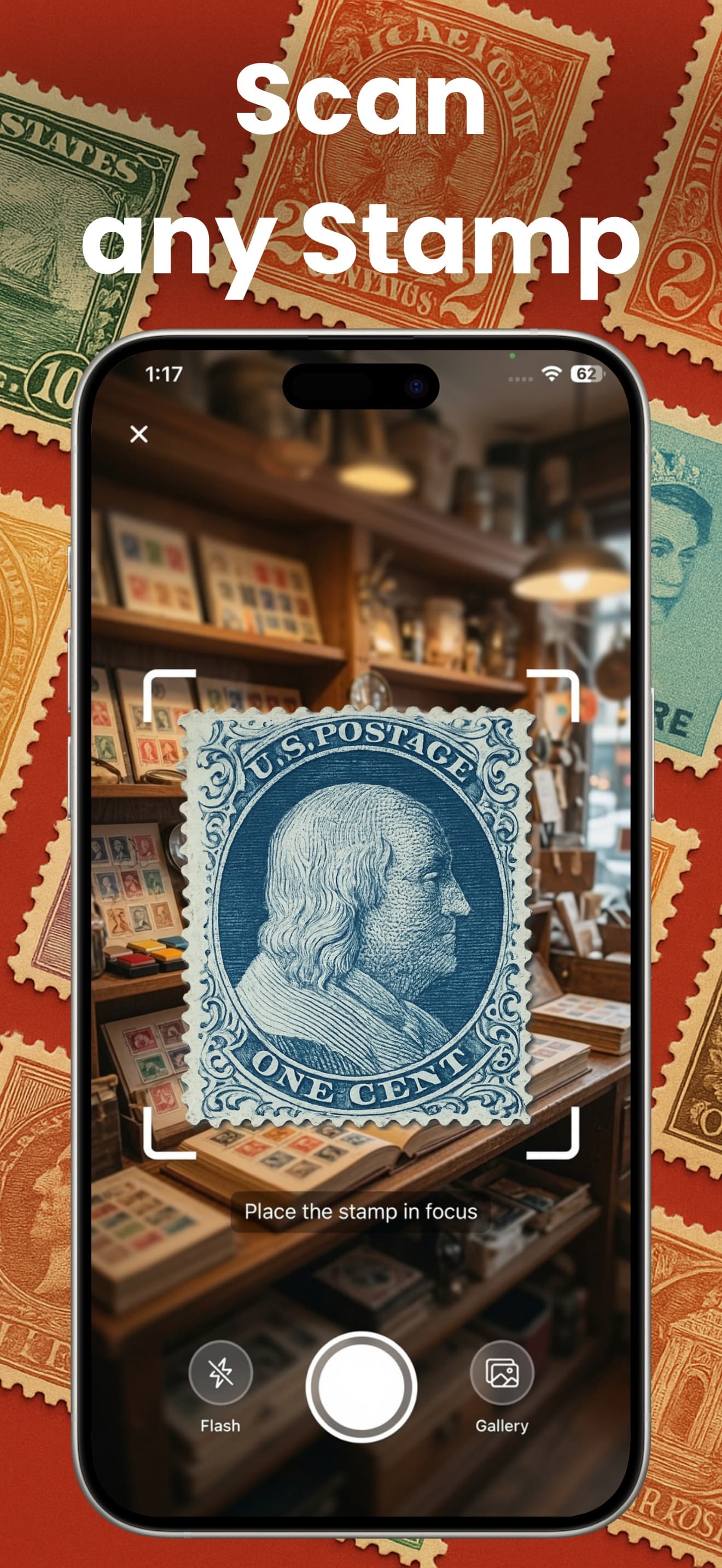
Scan the stamp
Tap Scan Now and photograph the stamp flat, with all four edges visible.
- 2
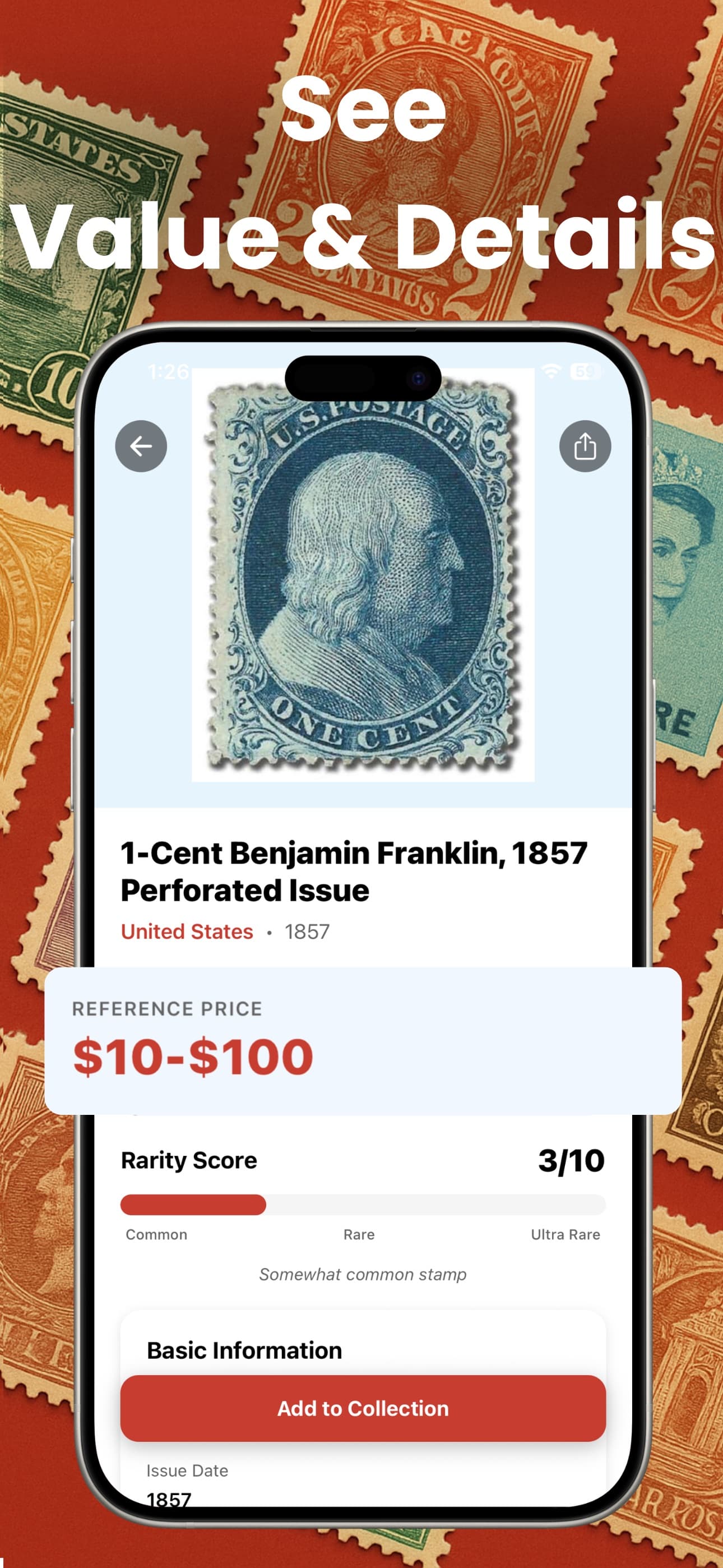
See the issue and price range
StampGo names the issue, such as the “1-Cent Benjamin Franklin, 1857 Perforated Issue”, with its year and a reference price.
- 3
Check varieties if it's promising
If the rarity score or price range is high, measure the perforations and check the watermark to pin down the exact variety.
- 4
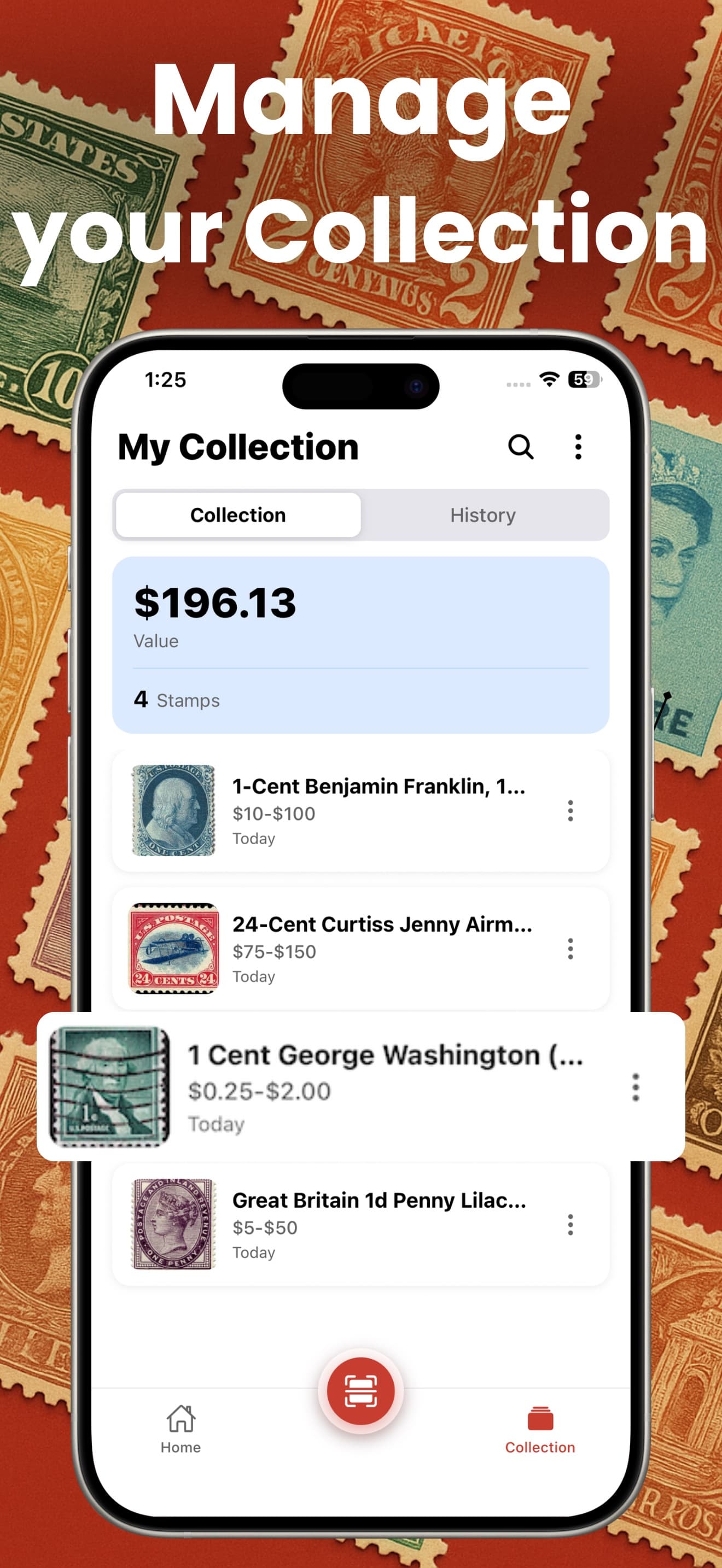
Save it to your collection
Add it to your collection. The app's screenshots show a 1¢ George Washington at $0.25–$2.00, which is typical for a common issue.


Descarga gratuita para iOS y Android
Preguntas frecuentes
¿Cuánto vale un sello rojo de George Washington?
La mayoría de los de 2 centavos rojos de Washington de 1890 a 1930 valen unos céntimos usados. Algunas variedades de la serie de 1908 a 1922, identificadas por dentado y filigrana, valen bastante más.
¿Cuál es el sello de Benjamin Franklin más valioso?
El 1 centavo Franklin Z Grill de 1868, del que solo se conocen dos ejemplares, es uno de los sellos estadounidenses más valiosos.
¿Cuál es el sello de George Washington más valioso?
Las emisiones tempranas raras de Washington y las variedades escasas de Washington-Franklin, como ciertos sellos en rollo y variedades de dentado, alcanzan los precios más altos. La variedad exacta y el estado deciden el valor.
¿Necesito un odontómetro para los sellos Washington-Franklin?
Sí, para todo lo que vaya más allá de la primera identificación. El dentado, la filigrana y el método de impresión son precisamente lo que separa un Washington-Franklin común de uno escaso.
¿Por qué hay tantas variedades de Washington-Franklin?
A lo largo de los 14 años de la serie, el Bureau of Engraving and Printing cambió papeles, filigranas, máquinas de dentar y prensas conforme se modernizaba. Cada cambio creó nuevas variedades de los mismos diseños.
