
Timbres célèbres
Timbres Washington et Franklin : ce que vaut le vôtre
Mis à jour le · 6 min de lecture · Par l’équipe StampGo
Réponse rapide
La plupart des timbres George Washington et Benjamin Franklin valent de quelques centimes à quelques dollars, car c'étaient des timbres américains du quotidien imprimés par milliards. Certains valent des centaines ou plus : les émissions du XIXe siècle et les variétés rares de la série Washington-Franklin de 1908 à 1922, qui ne diffèrent que par la dentelure, le filigrane et le procédé d'impression. StampGo identifie l'émission en photo.
L’essentiel
- Pourquoi on en voit partout
- Washington et Franklin figurent sur les timbres américains depuis la première émission de 1847
- La série délicate
- Les têtes Washington-Franklin (1908–1922) : environ 250 timbres différents
- Ce qui distingue les variétés
- Dentelure, filigrane, impression à plat ou rotative, et papier
- Petites valeurs du quotidien
- Le 1 cent vert et le 2 cents rouge, imprimés par milliards
- Les plus précieux
- Combinaisons rares de dentelure et de filigrane, roulettes, erreurs et émissions anciennes
- Outils nécessaires
- Odontomètre, cuvette à filigrane, réglet millimétré
How much is a George Washington stamp worth?
Most George Washington stamps are worth a few cents to a dollar. Washington appeared on the most common US stamps for over a century, so the value depends on the exact issue, variety and condition, not the portrait.
| Stamp | Typical value |
|---|---|
| Common 20th-century Washington stamps (1¢–3¢), used | A few cents |
| Washington-Franklin Heads (1908–1922), common varieties | Cents to a few dollars |
| Washington-Franklin Heads, scarce perforation or watermark varieties | Tens to hundreds of dollars, sometimes more |
| 19th-century Washington issues (1847–1890s) | Dollars to thousands, depending on the issue and condition |
| The 1932 Washington Bicentennial set | Mostly common |
The red 2¢ Washington, the letter-rate stamp for decades, is the classic example. Billions were used, so most are worth a few cents, but certain varieties printed on the wrong paper, perforated differently or from a different press are worth far more.
How much is a Benjamin Franklin stamp worth?
Most Franklin stamps are common too, but early Franklin issues can be valuable. The 1847 5¢ Franklin was one of the first two US stamps, and the 1¢ Franklins of the 1850s–60s are worth checking.
Franklin, the first Postmaster General, has appeared on US stamps since 1847. The 1¢ blue Franklin of 1851–1861 comes in several types that specialists separate by tiny design differences, and the 1861–1866 1¢ Franklin in StampGo's own screenshots carries a $15–$75 reference range. In the Washington-Franklin series, Franklin appears on the 1908 1¢ and, from 1912, on the higher values.
The rarest of all is the 1868 1¢ Franklin “Z Grill”, with only two known. It's one of the most valuable US stamps. See US stamp values.
Why is the Washington-Franklin series so hard to identify?
About 250 different stamps share a handful of designs. They were printed between 1908 and 1922 with different perforations, watermarks, papers and presses, and some combinations are far scarcer than others.
- Perforation gauge: perf 12, 10, 8½ or compound gauges such as 12 × 10, plus imperforate and coil stamps.
- Watermark: a double-line “USPS”, a single-line “USPS”, or none.
- Printing method: flat-plate and rotary-press stamps of the same design differ slightly in size.
- Paper: most were printed on ordinary paper, but some were printed on bluish or other unusual papers.
How do I identify my Washington or Franklin stamp?
Start with the denomination, color and design to find the issue, then measure the perforation gauge, check the watermark and measure the size to pin down the exact variety.
A photo gets you to the issue. For Washington-Franklins, the rest needs a perforation gauge, a watermark tray and a millimeter ruler. Our guide to how to identify stamps explains each tool.
Are 1 cent and 2 cent Washington stamps worth anything?
Usually only a few cents, because they were printed in the billions to pay everyday postage. The exceptions are scarce varieties and unused, well-centered copies of early issues.
Condition matters a lot for the better varieties, so check centering and gum before you compare prices. See stamp condition grades.
What's the difference between flat-plate and rotary-press stamps?
They're the same designs printed on different presses. Rotary-press stamps were printed from curved plates, which stretched the image slightly, so they're a fraction of a millimeter taller or wider than flat-plate stamps of the same design.
Rotary presses were first used for coil stamps in the mid-1910s and later for sheet stamps. To tell the two apart, measure the printed design with a millimeter ruler and compare it with a catalogue's dimensions. Many rotary-press stamps from the 1920s onward also show faint ridges on the back from gum breakers, which were used to stop the sheets curling.
It matters because some Washington-Franklin values are common in one printing and scarce in the other, even with the same perforation and watermark. That's why careful collectors check all three: perforation, watermark and press.
Étape par étape
How to check a Washington or Franklin stamp with StampGo
StampGo narrows down which Washington or Franklin issue you have from a photo, so you know whether it's worth getting out the perforation gauge.
- 1
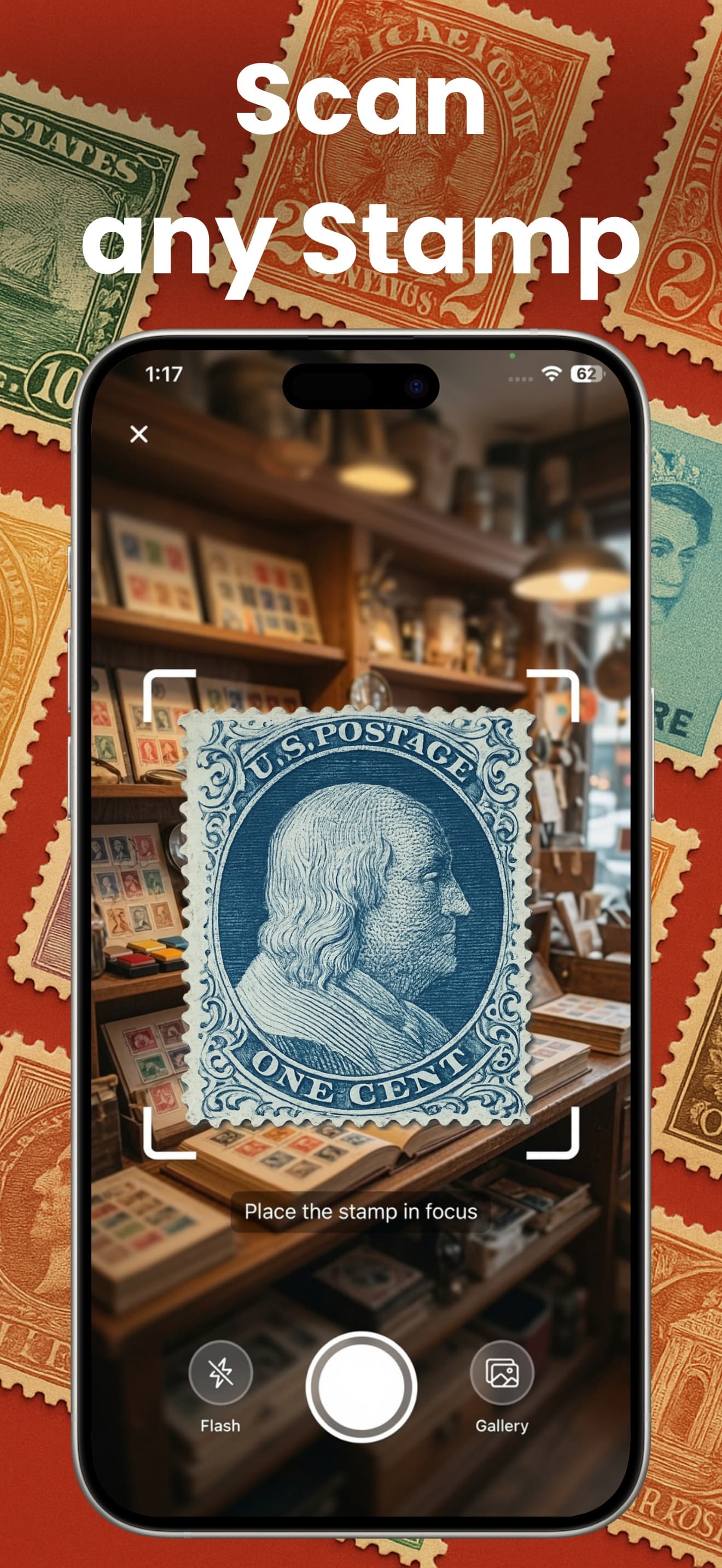
Scan the stamp
Tap Scan Now and photograph the stamp flat, with all four edges visible.
- 2
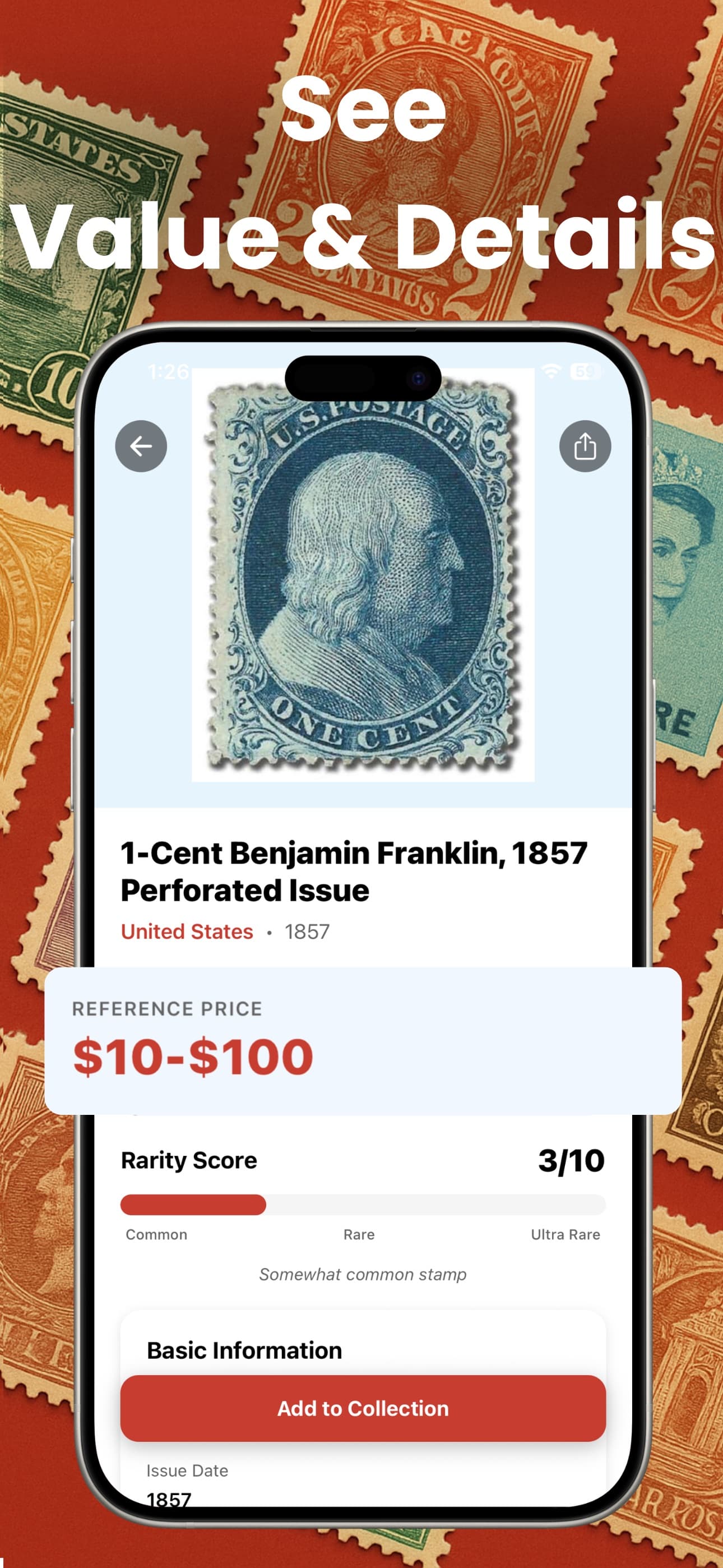
See the issue and price range
StampGo names the issue, such as the “1-Cent Benjamin Franklin, 1857 Perforated Issue”, with its year and a reference price.
- 3
Check varieties if it's promising
If the rarity score or price range is high, measure the perforations and check the watermark to pin down the exact variety.
- 4
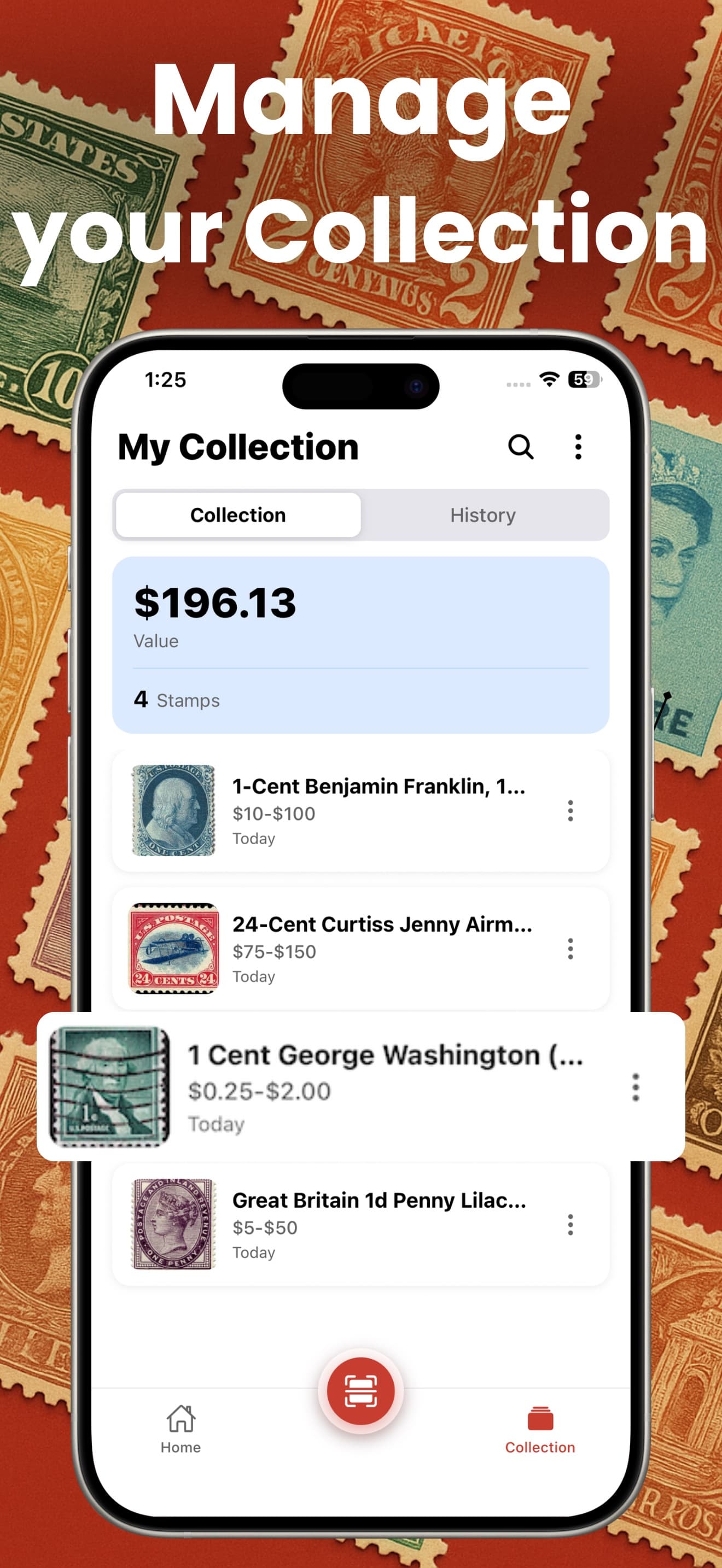
Save it to your collection
Add it to your collection. The app's screenshots show a 1¢ George Washington at $0.25–$2.00, which is typical for a common issue.


Téléchargement gratuit sur iOS et Android
Questions fréquentes
Combien vaut un timbre rouge George Washington ?
La plupart des 2 cents rouges Washington de 1890 à 1930 valent quelques centimes oblitérés. Certaines variétés de la série de 1908 à 1922, identifiées par la dentelure et le filigrane, valent bien davantage.
Quel est le timbre Benjamin Franklin le plus précieux ?
Le 1 cent Franklin Z Grill de 1868, dont seuls deux exemplaires sont connus, figure parmi les timbres américains les plus précieux.
Quel est le timbre George Washington le plus précieux ?
Les émissions Washington anciennes et rares et les variétés Washington-Franklin peu fréquentes, comme certaines roulettes et variétés de dentelure, atteignent les prix les plus élevés. La variété exacte et l'état décident de la valeur.
Faut-il un odontomètre pour les timbres Washington-Franklin ?
Oui, dès que vous dépassez la première identification. Dentelure, filigrane et procédé d'impression sont précisément ce qui sépare un Washington-Franklin courant d'un exemplaire rare.
Pourquoi y a-t-il autant de variétés Washington-Franklin ?
En quatorze ans de série, le Bureau of Engraving and Printing a changé de papiers, de filigranes, de machines à dentelure et de presses au fil de sa modernisation. Chaque changement a créé de nouvelles variétés des mêmes dessins.
